
Here are a few tips for Karmann-Ghia owners and interested buyers:
|
A Karmann can rust on all sides, but it is no more prone to rust than
other cars. But take heed before buying a rust cover! The body is thicker
than that of today's cars. Replacement bodies and spare parts are still
available but can quickly end up costing more than the car is worth.
One should particularly check for rust in the following areas:
|

|
The engine is relatively unproblematic, as enough spare parts can be obtained
from VW beetle and other VW models, some of which are still being built
in South America.
It is more problematic, however, if you want to preserve the original engine. A few parts were used only in the Karmann-Ghia. The interior poses a more difficult problem. For example, seats cannot simply be taken from VW beetles, as Karmann-Ghia seats are lower. They should be in good shape at the time of purchase. As my driver's seat has starting to get some big holes, I was going to have to get it re-upholstered. Thus far, I have been unable to get my hands on any of the original upholstery material, Hahnentrittplatin - just an intact seat-back. In contrast to almost all other VW models, the Karmann-Ghia has a frameless door window - thus some people initially encounter problems in installing and removing them. Materials such as windshield wipers can unfortunately no longer be purchased at every service station. Thus one should keep a supply of these or find some alternative solution.
|
|
As I'm not so crazy about the Asian tires purchased by my car's previous
owner (poor grip under wet conditions), I am looking for a replacement.
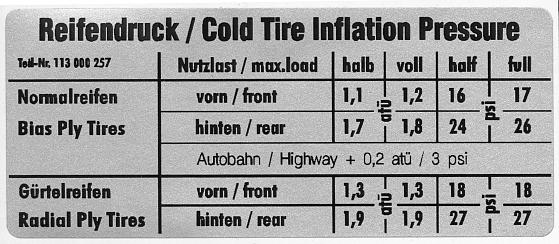
I have been looking long and hard for whitewall tires suitable for everyday use from a name-brand manufacturer, but as yet haven't found anything to my satisfaction. I won't put the usual decorative white rings on my car, as over time they damage the tires. Here in Berlin, only Firestone and Vredestein seem to offer tires in normal sizes. As a friend had warned me that Firestone tires can have adhesion problems under wet conditions, I opted for the Vredestein ones (155SR15 Sprint ST). Over 10,000 km and a rainy German summer later, I haven't regretted this decision -- the difference to the Asian tires is in any event pronounced. The young mechanic who fitted my tires was very surprised when, in response to my inquiry, he was obliged to reduce the tire pressure from the usual 2 atmospheric excess pressure to 1.3 in the front and 1.9 in the back. When I had to explain to him how the windshield washers windshield washers work while he was replacing the spare tire, he started looking around for the hidden camera... My snow tires are also from Vredestein (155SR15 SNOW +). While shopping for them in December 1998, I found that they were no longer so easy to find. I had to wait a whole week to get some from large tire dealer -- the smaller dealers either couldn't or didn't want to make me an offer.
|

|
In some situations, the Karmann's road performance takes some getting
used to.
Thus, on a slippery surface (fallen leaves, slush), one should go easy on the gas - otherwise the car will go into a rear spin and can only be righted by if one instantly turns the steering wheel in the opposite direction. When braking on curves, one should always keep in mind the light weight of the front end and of the car in general. At high speeds, the car tends to move straight forward, so don't go speeding around dangerous curves. Night driving isn't much fun with an aged windshield and outmoded headlight technology. Nighttime drives along unfamiliar, narrow country roads when there is no moon aren't very pleasant and should best be avoided. I have never done the elk test, but thanks to its low stature, the Karmann should be able to pass it... provided that the bumpers and everything else are in good shape. Nevertheless, in the 1960s a type 3 VW had trouble with elks, tipping over during a test drive by a motor magazine.
|

|
In purchasing a Karmann-Ghia, one should bear in mind that every model
year has its advantages and disadvantages.
On this point, there are two contradictory principles:
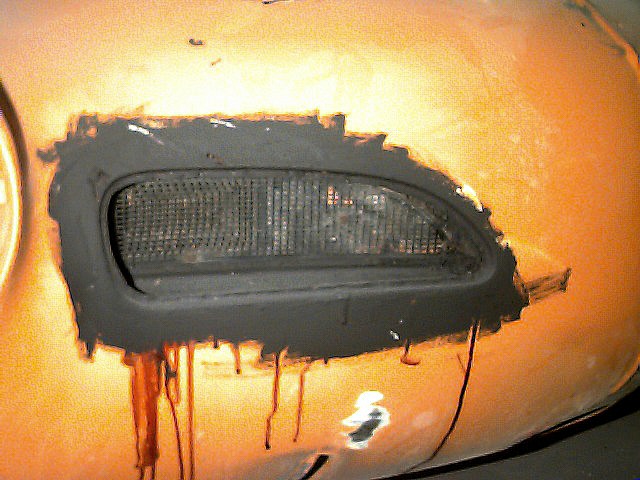
Older models usually have weaker engines. They didn't benefit from technological improvements or from improved safety measures, such as the 3-point safety belt and head supports; they might still have 6-volt engineering (think about the car radio). Newer models have simple square bumpers, relatively large taillights that clash with the original design, and have not-very-nice-looking large, square front turn signals. I must confess that I did not search long for my Karmann-Ghia but rather instantly fell in love with one that was parked by the side of the road with a "for sale" sign in the window and just went for it. I am happy that, as a spring 1970 model, it represents a good compromise between the two principles. The only feature that I don't like are the square front turn signals.
|
|
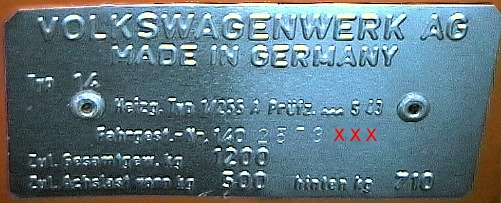
The chassis plaque is located in the trunk at the height of the spare tire on
the passenger side. It contains some coded information on the vehicle.
For one, the vehicle type is in the upper left-hand corner. Type 14 is the round, first Karmann-Ghia. The chassis number includes at the beginning the type again (14), followed by a code for the year of manufacture (5=1965, 6=1966, ..., 0=1970, ..., 4=1974, etc.). My chassis number begins with 140, which stand for type 14, year 1970. In addition, the maximum weight and axle burden are located on the plaque. The chassis number can also be found inside the car, stamped on the middle tunnel under the removable seat-back (see picture; I have crossed out the last three digits of my chassis number!). I have heard that they refer to color codes and other information - I couldn't find any evidence for this.
|

|
Not all Karmann-Ghias around today still bear their original color. Some
owners, while restoring their vehicles, chose to repaint them in their
favorite color rather than in the one that they received in the factory.
The original color plaque is normally located in the trunk at the height of the spare tire on the passenger side. It is typically silver embossed with black lettering. Should it be missing, one can inquire at the "Stiftung AutoMuseum Volkswagen" (for this consult by Address page). At the very least, a dealer in spare parts (Neuffer) will have a limited selection of replacement plaques (for monochrome paint jobs only).
|

|
Not everyone lives in the sunny South or has a heated garage. The heating
system in the Karmann-Ghia is, as in the beetle, modestly designed. The
heat exchangers are often short-lived and have to be replaced at
considerable expense -- at the very latest when one can start to smell
gas or exhaust.
In the depths of winter this can also get very unpleasant -- particularly on short trips, when the car doesn't have a chance to warm up. If the problem is limited to fogged-up windows, it's enough to wipe them down with an ordinary chamois cloth and open the windows without letting the heated air enter the inside of the car. Thus, the best way to get through short autumn trips is to dress warmly. But as soon as it gets really cold and the windows start freezing over from the inside, I can only recommend that one install a stationary heating system (mine was manufactured by the Eberspächer). company.) But at approximately DM 2,500, they aren't cheap, so it's only worth it if one uses the car a lot during the winter. However, with such a system, one can really enjoy driving through wintry landscapes. I was lucky in that the factory-installed heated rear windscreen in my Karmann-Ghia still works. At a few meetings I've seen cars with (non-original) heating mechanisms stuck on to the rear windows, but I don't know where they come from.
|
